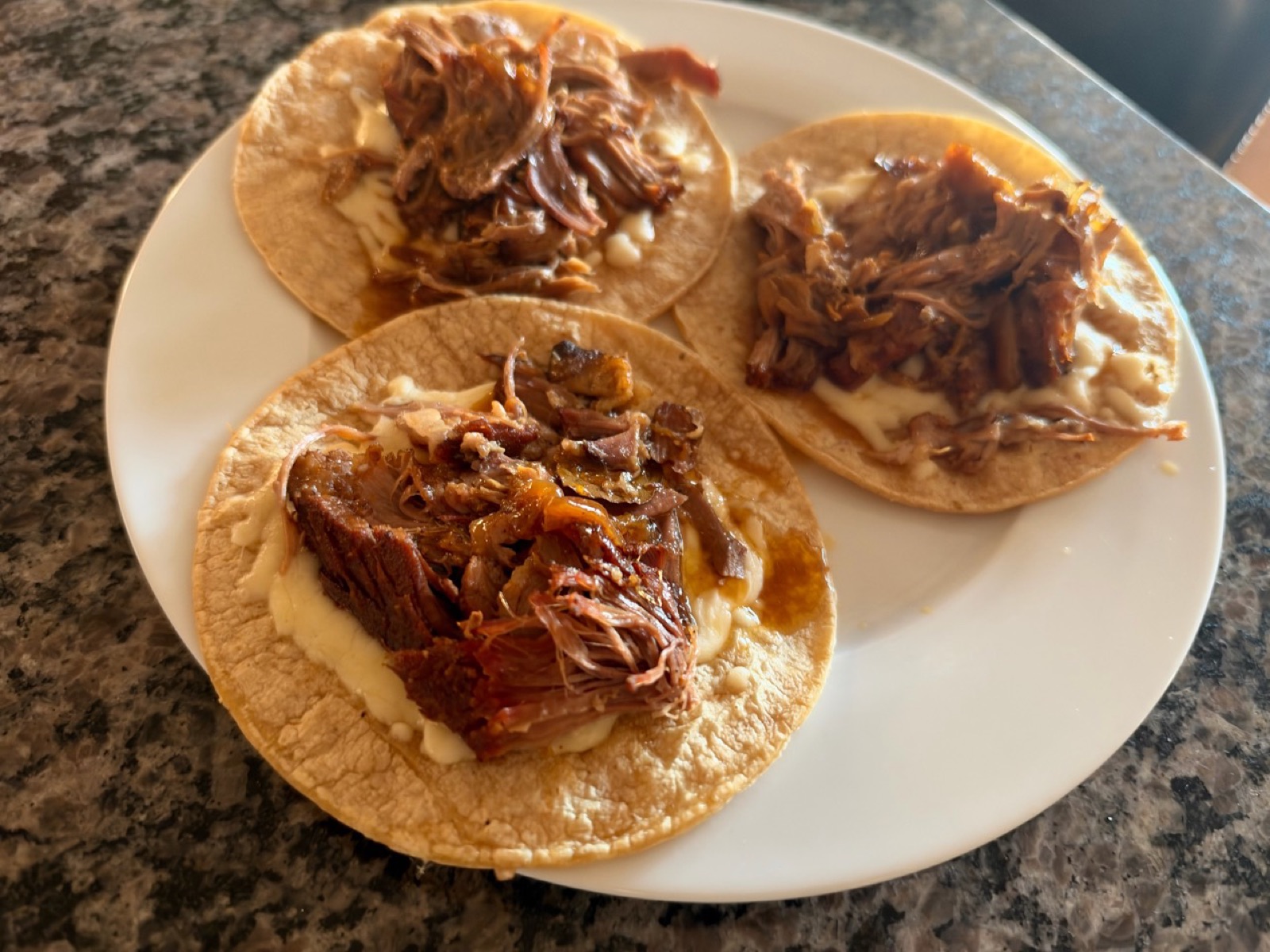
My earlier Dutch Oven Pulled Pork uses a barbecue rub, vinegar, and sauce. For these carnitas, I want tender, well-seasoned pork ready for a warm tortilla, onion, cilantro, and salsa. A crisp finish is optional.
This version starts with a four-pound, bone-in shoulder and an overnight dry brine. A little orange and garlic season the pork as it cooks. I use avocado oil in the Dutch oven and pull the cooked meat into large pieces. It is ready to serve at that point, with an optional skillet finish for browned edges. The New Mexico chile is an optional addition; the pork should still be the main flavor.
Yield: 6–8 servings with tortillas and sides. The four-pound starting weight includes the bone.
Oven setting: I used 250°F (120°C) convection roast. For a conventional oven, use 275°F (135°C). If your oven automatically converts conventional temperatures for convection, check its instructions so you do not apply the reduction twice. Keep the Dutch oven covered and use the tenderness checks below; the two settings may take different amounts of time.
Time: Allow 8–24 hours for the overnight dry brine, plus about 6 hours 35 minutes of preparation and cooking: 20 minutes to prepare, about 6 hours to braise, and 15 minutes to rest and prepare the juices. Active work is about 30–35 minutes across both days. Optional crisping adds about 25 minutes, bringing the total to about 7 hours. The prep and cook times above exclude the overnight wait and optional crisping. Start checking tenderness before six hours; a thick shoulder can take longer.
Equipment: A snug 5–6-quart Dutch oven with a tight-fitting lid, a rack and rimmed tray for the dry brine, tongs, a slotted spoon, two forks, and a measuring jug. For optional crisping, use a large cast-iron or heavy stainless-steel skillet. An instant-read thermometer is useful. If your Dutch oven is larger, check the liquid carefully during cooking.
Ingredients
Pork and overnight seasoning
- 1 bone-in pork shoulder or Boston butt, about 4 pounds, skin removed if present; keep it whole
- 14 grams kosher salt, about 5 teaspoons Diamond Crystal or 3 teaspoons Morton, plus more to taste after cooking
- 1 teaspoon freshly ground black pepper
- 1 teaspoon dried Mexican oregano
- 1 teaspoon ground New Mexico red chile, optional; use ½ teaspoon if yours is hot
For the Dutch oven
- 2 tablespoons avocado oil
- 1 medium yellow onion, quartered
- 6 garlic cloves, peeled and smashed
- ½ cup fresh navel orange juice, from about 1–2 oranges
- 2 strips orange zest, each about 2 inches long, cut from a scrubbed orange with a vegetable peeler; avoid the white pith
- ¼ cup water, plus more as needed in ¼-cup increments
- 2 dried bay leaves
- 1 small piece of cinnamon stick, about 1 inch long, optional
To finish
- ¼ cup defatted cooking juices, reserved from the pot
- Optional: ¼ cup additional avocado oil for crisping, divided into 4 tablespoons
To serve
- Warm corn tortillas
- Diced white onion
- Chopped cilantro
- Lime wedges
- Salsa verde or salsa roja
Let’s make it
-
Dry-brine the pork the night before. Remove any skin and only thick, hard exterior fat from the 4-pound bone-in shoulder. Keep a thin fat layer and the fat between the muscles. Pat dry. Mix 14 grams kosher salt (about 5 teaspoons Diamond Crystal or 3 teaspoons Morton), 1 teaspoon black pepper, 1 teaspoon Mexican oregano, and the optional 1 teaspoon New Mexico chile (½ teaspoon if hot). Rub the full mixture over the pork, including its natural creases. Set it on a rack over a rimmed tray and refrigerate uncovered for 8–24 hours, on the bottom shelf away from other food. Without a rack, use a shallow dish that catches the juices. Keep the citrus, water, and avocado oil for the next day.
-
Set up the Dutch oven. The next day, heat the oven to 250°F (120°C) convection roast or 275°F (135°C) conventional, with a rack in the lower third. Keep the pork refrigerated until you are ready to cook. Do not rinse it or add more salt. Add 2 tablespoons avocado oil to the Dutch oven. Add 1 quartered medium yellow onion, 6 smashed garlic cloves, ½ cup fresh orange juice, 2 strips orange zest, ¼ cup water, 2 bay leaves, and the optional 1-inch piece of cinnamon stick. Set the pork in the pot, fat side up. The liquid should cover the bottom in a shallow layer; it does not need to come halfway up the meat. Add water in ¼-cup increments only if needed to cover the bottom. Bring the liquid to a gentle simmer and cover tightly. The pork goes in without an initial sear. If you want browned edges, use the optional skillet step after it is tender. Discard the raw juices from the dry-brining tray and wash it before reuse.
-
Cook gently until the bone releases. Put the covered pot in the oven at 250°F (120°C) convection roast or 275°F (135°C) conventional. At about 3 hours, remove the 2 strips orange zest and the optional cinnamon piece with a slotted spoon. Check that some liquid remains beneath the fat. If the bottom is nearly dry or the onion is catching, carefully add ¼ cup hot water and cover again. Start testing the meat at about 4½–5 hours. A fork should turn easily in the thickest part, and the bone should pull free with little resistance. A thermometer will often read around 195–205°F (90–96°C) away from the bone, but tenderness decides when it is ready. Expect about 6 hours. If it still resists, continue covered in 30-minute intervals. If it is tender earlier, take it out.
-
Rest and separate the fat from the juices. Lift the pork onto a clean rimmed tray, supporting it with a slotted spoon. Rest for 10–15 minutes. Remove the 2 bay leaves and any remaining zest or cinnamon. Strain the pot liquid into a heatproof jug and let it settle. Skim the excess fat from the top to reach the cooking juices beneath it. If those juices taste weak, simmer them for 5–10 minutes to concentrate them, stopping before they become too salty. Measure ¼ cup defatted juices for the pork. If you have less, add just enough water to reach ¼ cup. Reserve any extra juices for serving.
-
Pull into large pieces. Remove the bone and any firm connective tissue. Pull the pork into rough 1–2-inch pieces with two forks or tongs. Stop before it becomes a pile of fine strands. Toss the pork with the ¼ cup measured cooking juices. Taste a piece from the center and add kosher salt only if needed, a small pinch at a time. Serve now for soft, juicy carnitas, or continue to the optional crisping step.
-
Optional: crisp in avocado oil. Divide the seasoned pork into 4 roughly equal batches. Heat a large skillet over medium-high heat and add 1 tablespoon additional avocado oil. Spread the first batch in a single layer with space between the pieces. The pork already has its cooking juices; do not add more liquid to the skillet. Cook undisturbed for 3–4 minutes, until the underside has a brown crust. Turn the pieces and cook for 1–2 minutes more. Adjust the heat if the oil smokes or the seasoning darkens too quickly. Repeat with the other 3 batches, using 1 tablespoon avocado oil for each batch. This uses the full ¼ cup additional avocado oil. Aim for one or two browned sides and a soft center. Serve each batch promptly.
What Makes the Difference
Cook until tender. If the pork fights the fork, it needs more covered cooking. Browning a tough piece will not make it tender. Six hours is a planning estimate, not a required stopping point.
Taste before serving. The overnight salt seasons the shoulder, but the pulled meat may still need a small adjustment. Taste before adding more salt, especially if you reduced the juices.
Use only a little juice before crisping. A crowded skillet or a pool of broth makes the pork steam. The ¼ cup of juice mixed through the pork gives each of the four batches about 1 tablespoon. Serve extra juices on the side.
Keep some large pieces soft inside. Fine shreds dry quickly. If you choose to crisp the pork, brown a few surfaces, then stop while the centers are still moist. Add lime at the table for a fresh finish.
The optional tender-then-brown finish follows the principle in Rick Bayless's home-style carnitas. This recipe adapts that approach for a whole, bone-in shoulder, a longer covered cook, avocado oil, and an optional skillet finish.
Serving Suggestions
Serve in warm corn tortillas with diced white onion, cilantro, salsa verde or salsa roja, and lime wedges. Rice and beans make it a full meal. Serve the pork soft from the pot or with crisp edges. Add lime at the table.
If you want a crisp finish for only part of the pork, use 1 tablespoon additional avocado oil for one-quarter of the cooked, seasoned pork. Serve the rest soft, or save it for another meal.