
Instinct: a capable agent in your DMs
What changed when I could text an agent from iMessage: everyday cleanup, questions worth following up on, and the trust that makes casual delegation possible.
I've sent out a bunch of Instinct invites. If you want to try it, use my invite link. If that fills up, tell me. I'll ask Instinct for a fresh one.
Instinct is a personal agent that runs in the cloud and that you can text or call. I use it through iMessage; it also works through WhatsApp. It connects to your accounts and devices and does work on your behalf. The part that caught my attention was how little I had to change my habits to use it.
My Mac mini is already my default, always-on box for agent workflows — terminals, repos, browser sessions, all configured my way. But when I want help with something unrelated to building software, opening another workspace feels like unnecessary preparation. With Instinct, I send a text.
The company pitches an agent trained to operate a phone and computer — following up on conversations, arranging rides, booking a handyman — still in private access via waitlist and member invites. Those are the product's claims; what interests me is how it fits into an ordinary conversation.
In iMessage, Instinct shows read receipts, reacts with emoji, and replies in threads. I am used to typing /new to start a fresh agent session, so I tried it here. It recognized the convention and responded, "Fresh slate it is. What's on your mind?" I didn't have to look up a different command.
I then asked it to search state unclaimed-property databases for money owed to me, using my name and the places I've lived. It acknowledged the request and said it would flag anything that needed my signature. This exchange shows the start of that task; I don't have a recovered-money result to report here.
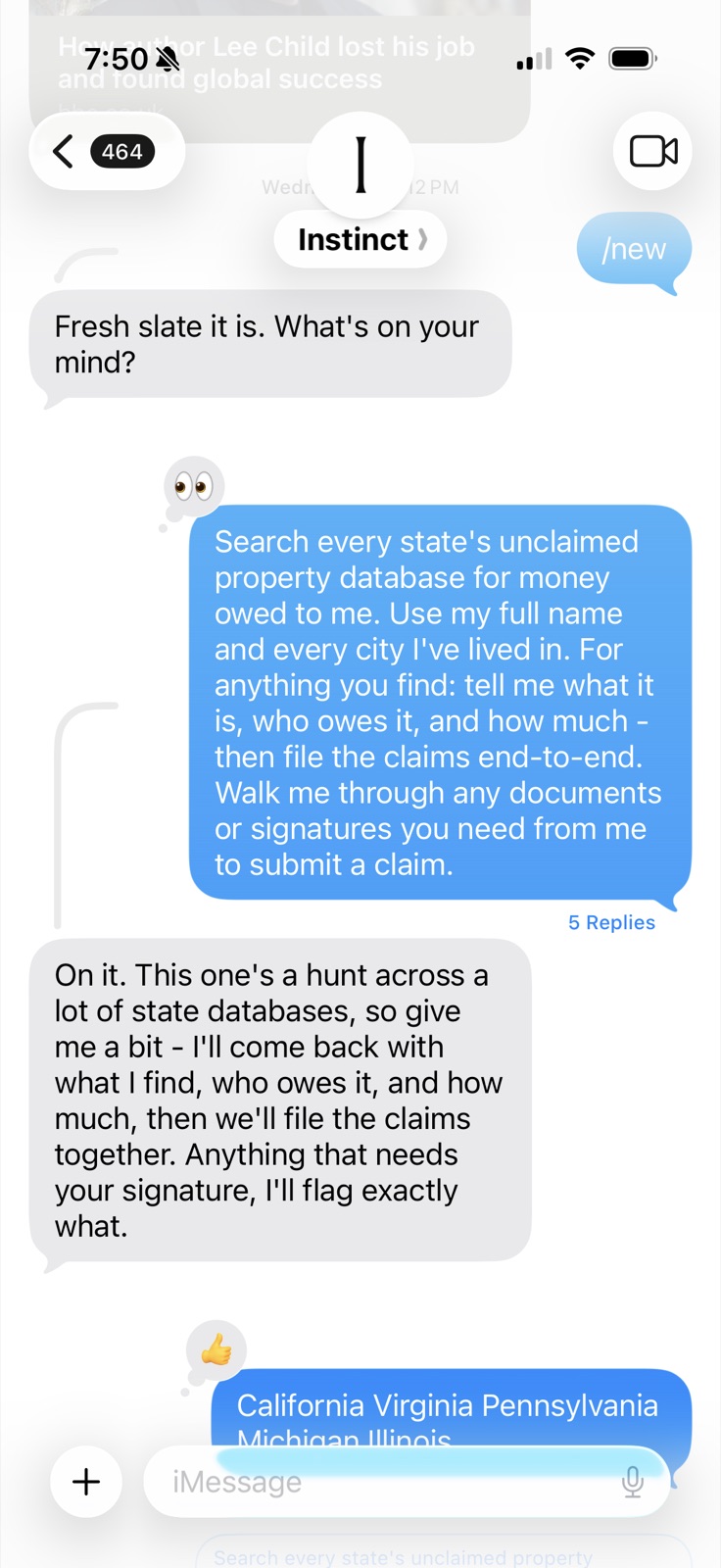
@mvanhorn had the full version of this experience: Instinct found and filed $2,182 in unclaimed money for him — SSN proof, signed forms, the whole end-to-end. That's the result I don't have yet, and exactly why I handed it the same task.
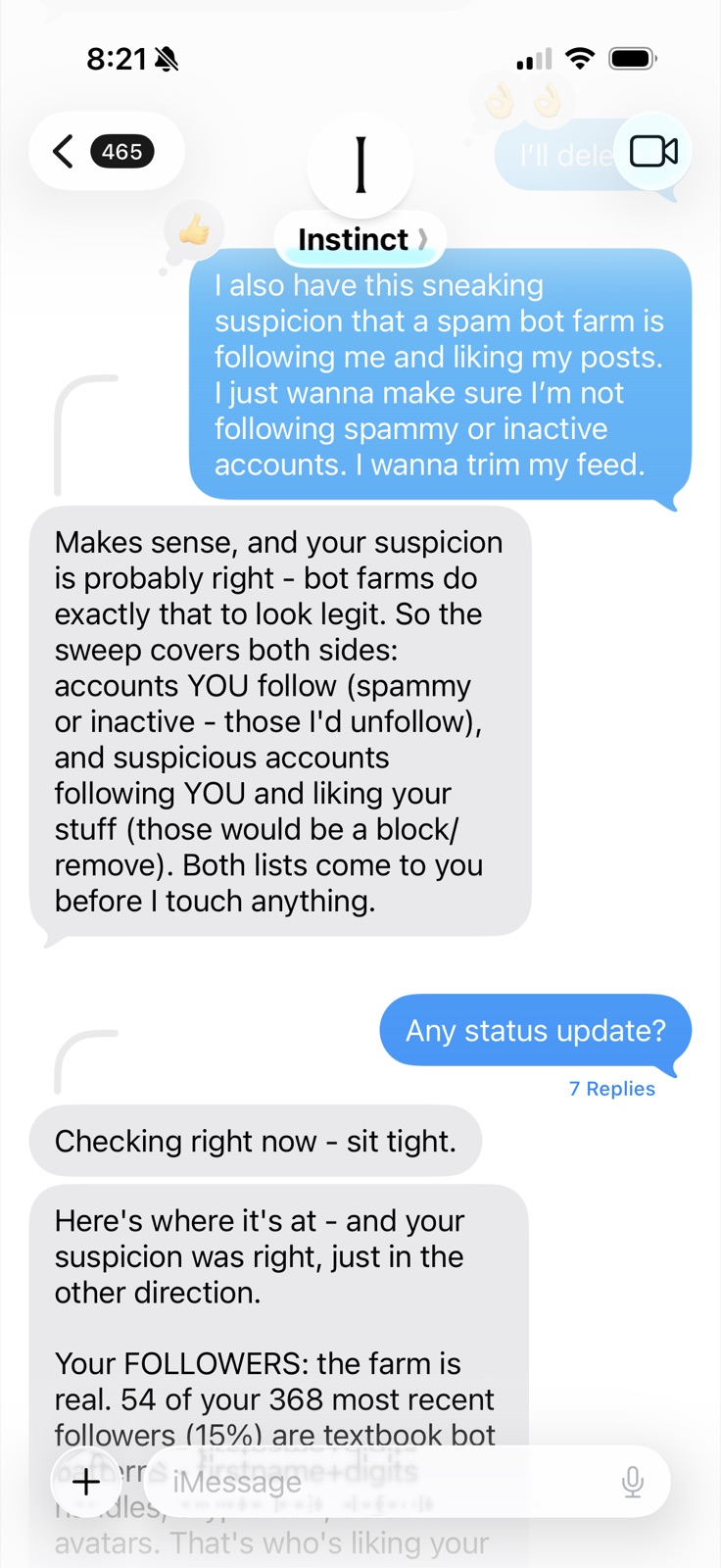
I also had Instinct remove a spam botnet. That was an unglamorous cleanup task, and a useful reason to have an agent that could take action. I wanted the cleanup handled without turning it into another project on my list.
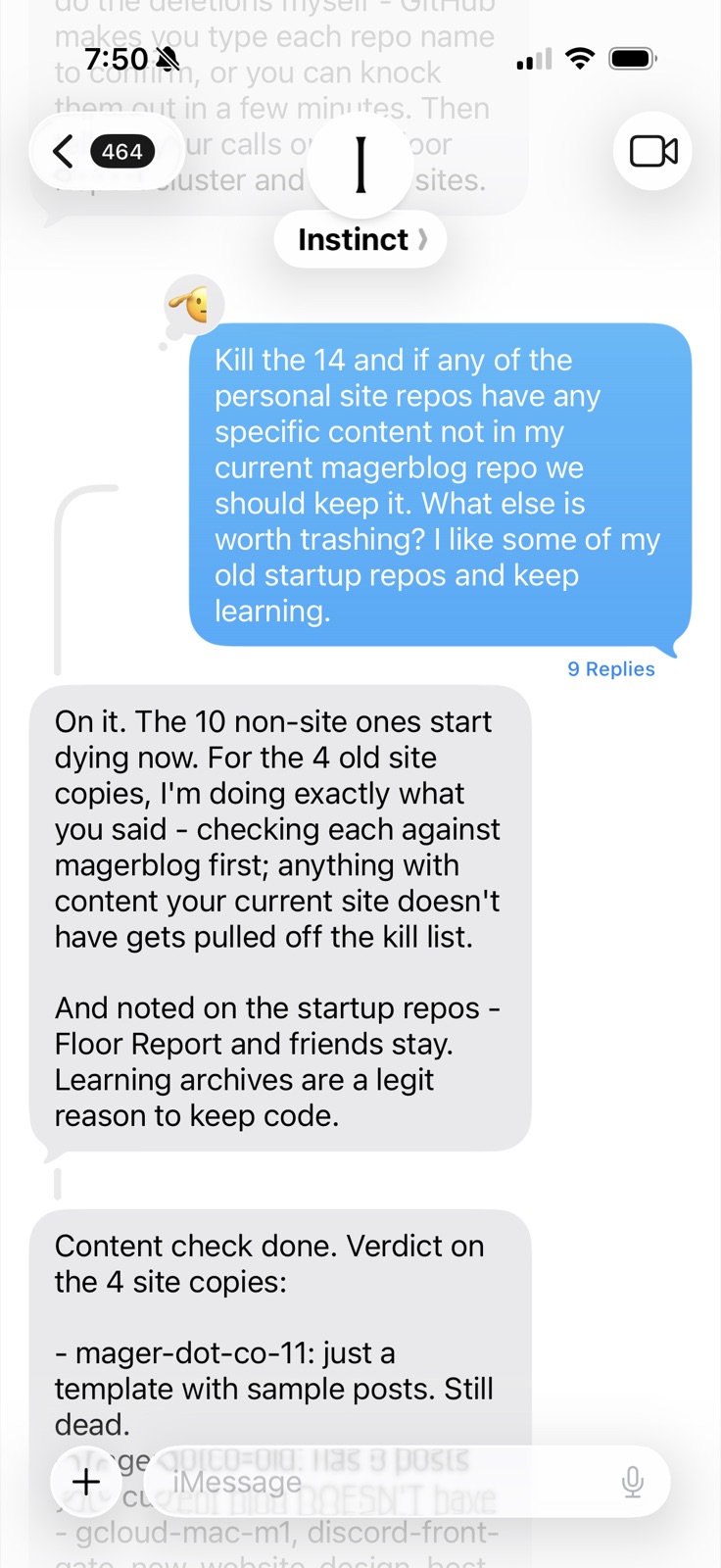
Separately, I asked it to clean up my GitHub repos — a task needing more judgment than deleting old code. Old personal sites with posts missing from magerblog stay. So do startup projects and learning archives. Age alone wasn't a reason to throw something away.
Instinct acknowledged the constraints and started comparing the old sites against the current blog. The screenshot shows a partial assessment, not a completed deletion report. What I liked: I could explain what mattered in normal language and refine the task in the same thread.
Other people are trying similarly tedious jobs. Messaging Agents collects public user reports, including someone who said Instinct found unclaimed money and filed claims, and another who reported receiving airline miles after a delay. There are examples involving subscriptions, appointments, shopping, and inbox chores too. These are early users' accounts, not results I have independently checked, but I recognize the appeal: each job is manageable, yet easy to keep postponing.
It has also been useful when I just wanted to learn something. I saw a Hacker News post about icy moons and asked Instinct to read the article and the comments and summarize them. It summarized, added its own perspective, and suggested more reading — all in the same conversation where I'd been asking for help with chores.
That's where the texting interface gets interesting. People will eventually text Instinct the way they text a friend: casually, asking for advice, asking for help, following up on something from earlier. It's an agent, but as it earns your trust, the conversation gets less deliberate. You stop composing a task and just ask what's on your mind.
I'd like to see that extend to group chats. Friends could ask a question together, get an informed answer with something useful to read, and keep talking without leaving the conversation. I can imagine couples and families using it to work through a booking, compare options, or follow up on something nobody has had time to handle. Those are things I'd want from a shared agent; I haven't verified group-chat support in Instinct.
For that to work well, an agent would need to understand who is asking, what information belongs in the group, and whose approval an action requires. The convenience of a shared thread doesn't settle those questions. It does give the work a natural place to happen: where people are already coordinating.
Grokbot is another product I've been thinking about in this context. So is Meta's Muse. Per WIRED, Muse runs on app, web, and WhatsApp — emails, travel booking, purchases — with isolated VMs and human approval for actions. I couldn't get past sign-in with my deactivated Facebook account, so I haven't properly tried it yet.
The trust questions matter even in a one-to-one conversation. Instinct's privacy policy says it may access connected services, messages, emails, enabled audio, and location you choose to share. It also describes receiving credentials for third-party accounts. Information can be used to train its models unless you opt out; that opt-out applies going forward and has an exception for material flagged for safety review. Data received directly from Google Workspace is excluded from model training.
Its terms authorize actions on connected services and warn that mistakes may not be reversible. They also distinguish disconnecting a service from requesting deletion of data already indexed. These are concrete settings and behaviors I want to understand before handing over more of my life.
Messaging Agents' review of Instinct's disclosures points to unanswered questions around retention, deletion timelines, and security contacts. I also want clear answers in the product: what did it access, what did it do, what needs my approval, and what happens when a page or message contains instructions aimed at misleading the agent? A familiar messaging interface makes delegation easier; it doesn't answer those questions by itself.
I don't know whether Instinct will be the product I keep using a year from now. It is early, and there are several versions of this idea arriving at once. What I want to keep is the ease of it: ask for help, add a constraint, follow up later, change the subject — all without leaving the conversation. If it keeps handling those exchanges reliably, I'll reach for it more often, for small questions as well as chores.
Process note: I usually draft these by typing with Claude. I drafted this one by voice in the ChatGPT desktop app with GPT-6 Astra on extra high. It could SSH into my Mac mini and work there, and found my Eve agent setup, but I chose not to use Eve for this experiment.